We're More Connected Than Ever — So Why Does Everyone Feel So Alone?
In 2023, the U.S. Surgeon General did something unusual. Dr. Vivek Murthy issued an advisory — the kind typically reserved for urgent public health threats like opioids or tobacco — about loneliness. He called it an epidemic. He said the health risks associated with social isolation are comparable to smoking 15 cigarettes a day.
Let that sit for a second.
We live in the most connected moment in human history. Most Americans carry a device in their pocket that provides instant access to billions of other people. And yet, by nearly every measurable indicator, we are lonelier than we've ever been.
Something is very wrong with how we've defined "connection."
The Numbers Are Hard to Ignore
Before the pandemic, surveys were already painting a troubling picture. A 2018 Cigna study found that nearly half of Americans reported sometimes or always feeling alone. A significant share reported having no meaningful in-person social interactions on a daily basis. Among Gen Z — the first generation to grow up entirely online — rates of loneliness were the highest of any age group.
Then the pandemic hit, and isolation that was once a quiet background condition became impossible to ignore. And while some hoped that a return to "normal" would reverse the trend, the data suggests the loneliness epidemic has structural roots that predate COVID-19 by decades.
The physical health consequences are not abstract. Chronic loneliness is associated with elevated inflammatory markers, disrupted sleep, weakened immune response, higher rates of depression and anxiety, increased risk of dementia, and significantly higher all-cause mortality. The Surgeon General's comparison to smoking isn't hyperbole — it's epidemiology.
The Illusion of Online Connection
Here's where it gets complicated. Social media platforms were built around a genuinely appealing premise: that technology could help people stay close to friends, find community, and feel less alone. And in some specific contexts — connecting with people who share rare medical conditions, maintaining long-distance relationships, organizing communities around shared interests — they deliver on that promise.
But the way most people actually use social platforms has very little to do with meaningful connection. It's more like watching a highlight reel of other people's lives from a comfortable distance. You're present, but not really there. You're aware of people, but not truly known by them.
Researchers draw an important distinction between what they call "passive" and "active" social media use. Passive use — scrolling, watching, observing — is consistently linked to increased feelings of loneliness, inadequacy, and low mood. Active use — direct messaging, commenting meaningfully, making plans — shows a much smaller negative effect and sometimes a neutral one.
The problem is that most of our phone time is passive. We scroll. We double-tap. We watch stories. We feel like we've "checked in" on people without actually connecting with them. And in the meantime, the neural pathways that crave genuine reciprocal human contact go unfed.
Why Your Brain Craves More Than a Notification
Human beings are wired for connection at a neurobiological level. In-person social interaction triggers the release of oxytocin, reduces cortisol, and activates reward circuits in ways that digital interaction simply doesn't replicate. Eye contact alone — a thing that essentially doesn't exist in text-based communication — activates a distinct set of social processing systems in the brain.
When we substitute screen-based interaction for embodied human contact, we're essentially eating empty calories. It looks like food, it registers briefly as food, but it doesn't nourish the underlying hunger. And just like a diet of highly processed food can leave you physically depleted despite consuming plenty of calories, a social life built primarily around digital engagement can leave you relationally depleted despite constant "activity."
This matters for your health in ways that go beyond mood. Chronic activation of the stress response — which loneliness reliably triggers — keeps cortisol elevated, promotes systemic inflammation, disrupts sleep architecture, and over time contributes to the same downstream health consequences we associate with other chronic stressors. Your immune system doesn't distinguish between the loneliness of isolation and the loneliness of being surrounded by acquaintances who don't really know you.
What Meaningful Connection Actually Looks Like
The antidote to loneliness isn't more social activity — it's more meaningful social activity. And research on what makes relationships health-protective is actually pretty clear.
The key ingredients are: frequency of contact, depth of self-disclosure, reciprocity, and a sense of being genuinely known and valued. Casual acquaintances and social media followers don't move the needle much. Close friendships — the kind where you can call someone when things go wrong and they actually show up — do.
Harvard's Study of Adult Development, one of the longest-running studies on human happiness and health, found that the quality of close relationships at midlife was a stronger predictor of healthy aging than cholesterol levels. Let that inform your daily priorities accordingly.
Practical Ways to Start Closing the Gap
Building genuine connection as an adult in America is genuinely hard. We're geographically mobile, time-poor, and culturally conditioned to equate asking for help or company with being a burden. But the investment is worth making.
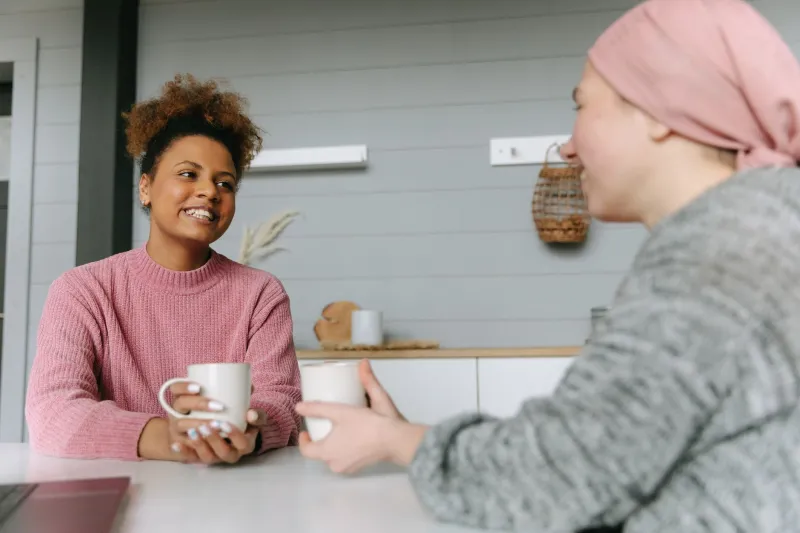
Go analog, regularly. Make a practice of at least one in-person social interaction per week that isn't incidental — not just bumping into a neighbor, but intentionally showing up for someone. A coffee, a walk, a shared meal.
Be the one who reaches out first. Most lonely people are waiting for someone else to initiate. Research shows that people consistently underestimate how much others want to hear from them. Send the text. Make the call. The awkwardness is smaller than you think.
Join something with recurring contact. The structure matters as much as the activity. A weekly running group, a book club, a recreational sports league, a faith community, a volunteer shift — repeated, low-stakes contact with the same people over time is how acquaintances become friends.
Be honest about how you're doing. Surface-level conversation is fine, but it doesn't build the depth that makes relationships protective. Vulnerability is a prerequisite for intimacy, and intimacy is what your nervous system is actually hungry for.
Audit your screen time with honesty. If you're spending three hours a day on social platforms and feeling lonelier, the connection isn't there. Redirect even a fraction of that time toward direct, reciprocal contact — a voice call instead of a scroll session, a text that asks a real question instead of a like on a post.
This Is a Health Issue, Full Stop
Loneliness doesn't get the same cultural attention as diet or exercise, but the evidence increasingly puts it in the same tier of health importance. Your daily habits around connection — who you reach out to, how you spend your evenings, whether you prioritize time with people who actually know you — are health behaviors, not just lifestyle preferences.
The Surgeon General's advisory wasn't a soft suggestion. It was a call to recognize that human beings need each other to survive and thrive — and that the digital substitutes we've built are, for most of us, falling short of that need.
The dose makes the medicine. And right now, for a lot of Americans, the dose of real human connection is dangerously low.